
If you’ve searched Google recently and noticed a block of text appearing above all the usual results — that’s AI search. And it’s not a test. It’s the new normal.
For business owners in Massachusetts, this shift changes something fundamental: how your customers find you.
This guide breaks it down in plain English — no jargon, no fluff. Just what’s happening, why it matters, and what to do next.
What Is AI Search?
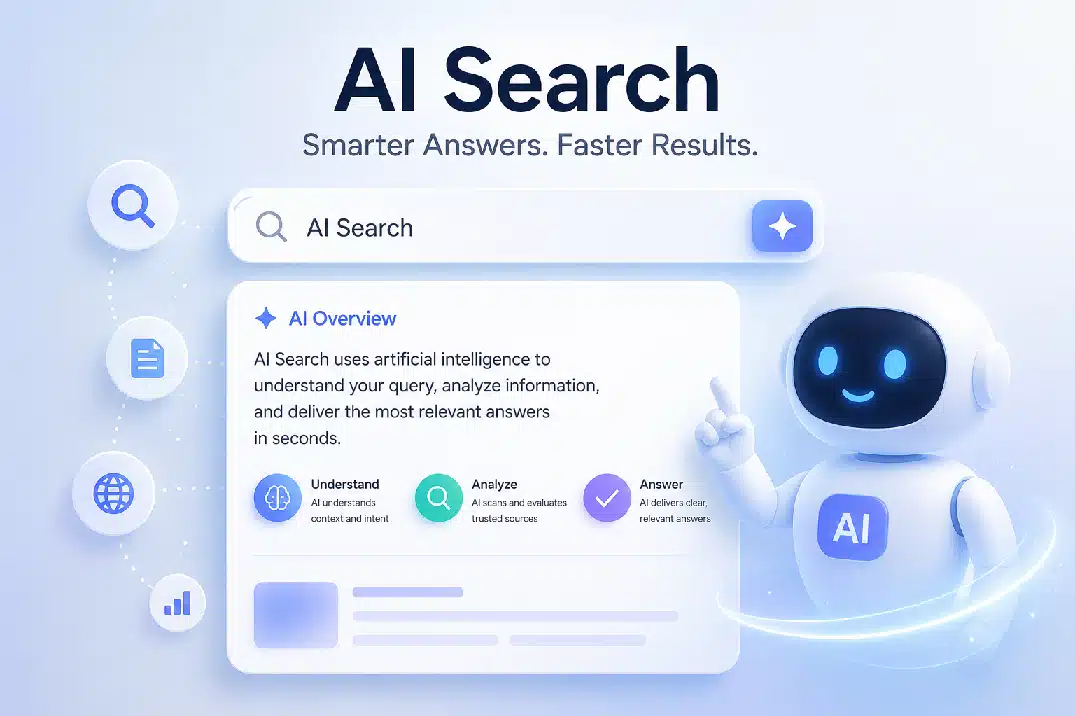
AI search is what happens when a search engine uses artificial intelligence to generate a direct answer to your question, instead of just showing you a list of links.
You’ve already seen it. Google calls theirs AI Overviews. ChatGPT has its own search. Perplexity AI is another. They all work differently, but they share one goal: give the user a complete answer without making them click around.
That’s a big deal for businesses. For decades, showing up on page one of Google meant potential customers would see your link, click it, and land on your website. AI search adds a new layer — a generated summary that appears before those links, often pulling from multiple sources at once.
If your business isn’t one of those sources, you’re invisible in that layer entirely.
How Is This Different from Regular Search?
Traditional search worked like a library index. Type in a keyword, get a ranked list of pages that contain it. The business with the best SEO rose to the top.
AI search works more like asking an expert. The AI reads across dozens of sources, synthesizes the information, and writes a response. It cites the sources it trusts — and ignores the ones it doesn’t.
| Traditional Search | AI Search |
| Shows a list of links | Generates a direct answer |
| Ranks by keywords + backlinks | Ranks by clarity, structure, and authority |
| User clicks to find information | User may never click at all |
| Local results via map pack | Local results woven into AI responses |
The rules haven’t changed completely – strong SEO still matters. But AI search adds new requirements on top.
Why Massachusetts Businesses Need to Pay Attention Now?
Here’s the local reality: AI search platforms are already surfacing local business recommendations in conversational results. When someone asks ChatGPT “best digital marketing agency near Boston” or “top-rated plumber in Worcester,” AI is forming an answer – based on your reviews, your website content, your online presence, and your Google Business Profile.
If those signals are weak, inconsistent, or missing, you won’t make the cut.
The businesses seeing early wins in AI search across Massachusetts are the ones that:
- Have clear, structured content that directly answers customer questions
- Maintain accurate and detailed Google Business Profiles
- Earn consistent, genuine reviews across platforms
- Publish location-specific content tied to the towns and cities they serve
This isn’t a future strategy. It’s a present one.
What Is the Difference Between SEO and AEO?
SEO (Search Engine Optimization) is the practice of optimizing your website to rank in traditional Google search results — the blue links.
AEO (Answer Engine Optimization) is the practice of structuring your content so that AI systems can extract, trust, and cite it in their generated responses.
In 2026, you need both. SEO builds your foundation. AEO gets you cited in the AI layer that sits above it.
Baystate Marketing specializes in both — see our Answer Engine Optimization and AI Optimization services for how we approach each.
Does AI Search Replace Google?
No — at least not yet. Google is still the dominant search platform by a wide margin, and AI Overviews are built into Google’s own results, not separate from them. What AI search does is change the format of results on Google and add new platforms (ChatGPT, Perplexity) that are growing fast.
The practical implication: you now need to optimize for the AI layer within Google, not just the traditional link results below it.
Will AI Search Hurt My Website Traffic?
It can — for certain types of content. Purely informational searches (“what are business hours,” “how does X work”) are increasingly answered by AI without a click. That traffic was always low-value anyway.
For local, transactional, and service-based queries — “marketing agency in Framingham,” “CDL training near Worcester,” “wedding transportation Boston” — the click is still happening. Customers researching a purchase or looking for a local provider still visit websites. AI search shapes which businesses they visit.
The goal is to be the business AI recommends.
How Do I Get My Business Into AI Search Results?
Three fundamentals move the needle:
- Structure your content to answer real questions.
AI systems favor content that leads with a clear, direct answer. Every page on your site should answer a specific question your customer is asking. - Strengthen your Google Business Profile.
AI pulls from GBP data for local recommendations — categories, services, reviews, photos, and Q&A all feed the model. An incomplete profile is a missed citation. Our Google Business Profile Optimization service covers this in full. - Build local authority.
Location-specific pages, local citations, and consistent NAP (name, address, phone) data across directories signal to AI that you’re a legitimate, established local business. This is the core of our Local SEO Services.
Not Sure Where You Stand?
Most Massachusetts businesses don’t know how they appear in AI search results – or whether they appear at all.
Free audit from Baystate Marketing gives you a clear picture in 60 seconds: how you show up online, where the gaps are, and what to fix first.
Get your free local SEO scorecard